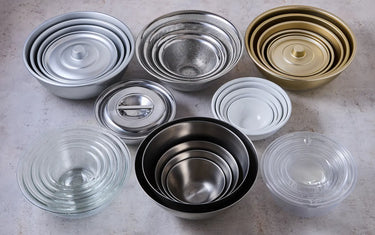
Products in this article:


Essential Picks Used by Professionals and Tips for Choosing the Right Bowl
Bowls are fundamental kitchen tools used for mixing and whisking ingredients.
They are indispensable throughout the cooking process, from prep work to final presentation. Bowls can be combined with colanders for washing and draining, or used alongside pots for bain-marie cooking and rapid cooling. Their versatility also makes them ideal for preparing and serving a wide range of dishes.
The choice of bowl can greatly impact efficiency, comfort, and results. Selecting the right material for your intended use is key. In this guide, we introduce recommended bowls along with their features and best applications.
Bowl Material Overview
Stainless Steel Bowls
Stainless steel bowls are a highly versatile option and the preferred choice in many professional kitchens. Their superior durability makes them a practical solution for long-term use. The difference between 18-8 and 18-0 stainless steel primarily comes down to nickel (Ni) content, which affects both corrosion resistance and pricing.
18-8 Stainless Steel Bowls

With 8% nickel content, 18-8 stainless steel offers excellent corrosion resistance and is non-magnetic. It is frequently used in high-quality kitchen equipment, including cutlery and sinks.
Our recommended bowls made from 18-8 stainless steel are designed for durability and cleanliness. They resist rust, are dishwasher-safe, and require minimal maintenance, ensuring reliable performance over time.
18-0 Stainless Steel Bowls

18-0 stainless steel contains no nickel and features magnetic properties. It is commonly used in induction-compatible cookware bases, kitchen utensils, and economical product lines.
Our recommended 18-0 stainless steel bowls are built for strength and long-lasting use. Resistant to rust and easy to handle due to their light weight, they offer a practical and cost-effective solution trusted by professionals and home cooks alike.
Features
- Highly resistant to rust with excellent durability
- Does not easily retain odors
- Resistant to both heat and cold (suitable for ice baths and bain-marie use)
Points to Note
- Not microwave-safe
- High thermal conductivity may cause the bowl to feel cold to the touch
- Prolonged contact with acidic or salty ingredients may cause discoloration
Best Uses
- General food preparation (versatile, all-purpose use)
- Whisking and mixing
- Cooling (e.g., ice bath preparation)
Aluminum Bowls
Aluminum bowls combine light weight with high thermal conductivity and durability, while offering good resistance to rust. Many are anodized to improve resistance to staining and scratching, as well as to reduce the risk of ingredient discoloration. Their efficient heat transfer allows for rapid cooling in ice baths, making them well-suited for professional use. Their retro-inspired design also adds visual appeal.
Silver Anodized Aluminum Bowls

These bowls are made from lightweight aluminum and treated with a silver anodized (sulfuric acid anodized) finish, significantly improving resistance to corrosion and surface wear. Their strong resistance to acidic and salty substances makes them a reliable, professional-grade option for prep work and ingredient storage.
Features
- High surface hardness enhances durability
- Cost-effective solution for everyday use
- Measurement markings support efficient preparation
Points to Note
- Sensitive to strong acids and alkalis; avoid vinegar, baking soda, and chlorine-based bleach
- Not compatible with dishwashers
- Prolonged contact with high-salt ingredients (e.g., umeboshi, miso) should be avoided
- Sudden temperature changes may cause deformation
- Abrasive cleaning tools can remove the anodized coating and should not be used
Gold Anodized Aluminum Bowls

These professional-grade bowls are made from lightweight aluminum and treated with a gold anodized (oxalic acid anodized) finish, enhancing durability and surface performance. The coating provides over twice the corrosion resistance of conventional sulfuric acid anodizing, ensuring excellent resistance to rust and making it suitable for use with acidic ingredients.
Features
- Enhanced hardness and corrosion resistance compared to standard anodizing
- Dense surface optimized for professional performance
Points to Note
- Despite its resistance, prolonged exposure to highly acidic or salty foods may lead to corrosion
- Direct heating or open flame use may cause deformation or degrade the coating
- Abrasive cleaning tools should not be used, as they can remove the anodized layer
Best Uses (for anodized aluminum products in general)
- Preparing large quantities
- Professional kitchens, including Japanese cuisine and pastry making
- Temperature-controlled tasks
- Best suited for users who value lightweight tools and efficient workflow
Enamel Bowls

Enamel bowls feature a metal core coated with a glass-like enamel layer, providing excellent durability, hygiene, and resistance to odor and staining. They are highly resistant to acidic and salty ingredients, making them a reliable option for food handling.
With both cooling and heat-retention properties, they help maintain food temperature when moving from refrigerator to table.
Depending on the model, they may be used with direct heat or in the oven, and their design allows for seamless transition from kitchen to table. Our recommended enamel bowls offer durability, cleanliness, and versatility. Suitable for storage and preparation, they resist acids and salt. While not compatible with microwave use, they support direct heat and oven applications.
Features
- Metal construction with a glass-like enamel coating
- Resistant to odor and color transfer
- Highly resistant to acids (suitable for vinegar and tomatoes)
Points to Note
- May chip upon impact, exposing the underlying metal
- Heavier than other materials
- Risk of damage if dropped
- Do not use metal scrubbers or abrasive cleansers, as they may scratch the surface
Best Uses
- Pickling (e.g., pickles, fermented foods)
- Storage for items such as jams
- Suitable for food preparation, especially with acidic ingredients
- Ideal for applications where hygiene and storage are priorities
Glass Bowls

Glass bowls provide excellent visibility and stability, making them ideal for mixing and direct serving. Their transparent design allows for precise preparation and presentation. Heat-resistant glass models are compatible with microwaves, ovens, and dishwashers, offering a hygienic solution that resists staining, odors, and acidic ingredients.
Our recommended bowls feature high-quality heat-resistant glass with a thermal tolerance of 120°C (248°F). Designed for efficiency, they handle preparation, cooking, and serving in a single vessel, helping reduce cleanup while maintaining cleanliness.
Features
- Chemically stable and non-reactive
- Heat-resistant; suitable for microwave and oven use
- Transparent design allows for easy visibility of contents
Points to Note
- Relatively heavy
- Risk of breakage
- Some types may be sensitive to sudden temperature changes
Best Uses
- Microwave cooking
- Preparing ingredients and heating in the same bowl
- Presentation-focused use
Plastic Bowls

Plastic bowls are a practical choice, offering light weight, impact resistance, and ease of handling. Their transparent design allows for quick visual checks, and their affordability makes them suitable for everyday use. Heat-resistant models are microwave-safe, adding further versatility.
In comparison to stainless steel and glass, they are more prone to staining, oil retention, and surface wear, and cannot be used in ovens.
Our recommended bowls are made from durable polycarbonate with excellent clarity. With heat resistance up to 140°C (284°F), they support microwave and dishwasher use. A deep structure and integrated pouring spout enhance efficiency during preparation.
Features
- Lightweight and shatter-resistant
- Transparent for easy visibility of contents
- Affordable and practical
Points to Note
- Prone to scratches
- May retain odors and oily residue
- Sensitive to high temperatures, with a risk of deformation
Best Uses
- Salads and light mixing tasks
- Suitable for children and outdoor use
- Temporary sorting and organizing
- Ideal for light-duty, everyday use
Bowl Lids
Lids provide added convenience for storage and portability. A range of materials is available to match different uses.
Stainless Steel Lids

Anodized Aluminum Lids

Oxalic Acid Anodized Aluminum Lids

Plastic Lids

Material Comparison Summary
| Material | Weight | Durability | Maintenance | Features |
|---|---|---|---|---|
| Stainless Steel | △ | ◎ | ◎ | Highly durable and widely used in professional kitchens |
| Aluminum | ◎ | ○ | ○ | Lightweight and easy to handle |
| Enamel | △ | ○ | △ | Ideal for baking due to excellent whipping performance |
| Glass | △ | △ | ◎ | Transparent and microwave-safe |
| Plastic | ○ | △ | ◎ | Lightweight and shatter-resistant |
Why One Bowl Isn’t Enough: Choose by Purpose

Choosing bowls according to their intended use is the most effective approach.
Start with a versatile stainless steel bowl. The Sori Yanagi bowl set offers a practical and well-balanced design suitable for a wide range of tasks.
Enhance your setup with aluminum bowls for efficiency, enamel bowls for storage, and glass bowls for microwave compatibility.
By selecting the right combination, you can significantly improve both workflow and results in the kitchen.