Products in this article:

Keep Your Wood and Rubber Cutting Boards Looking Fresh

Your cutting board is the foundation for all of your cooking. Nearly every dish needs an ingredient to be chopped, sliced, or diced. A sandwich needs some sliced onion, tempura needs chopped vegetables, sushi needs sliced fish, and so on. It’s no surprise, then, that your cutting board can look beaten up after years of use.
With a nice wooden or rubber board, you know that the little cuts and stains can build up over time. Eventually, those little cuts turn into deep gouges and stains build on top of stains. We know that cleaning our boards quickly can prevent many stains, but sometimes you’d rather spend time with friends or family rather than scrubbing away in the kitchen. Strict disciple is nice, but we also need to let our hair down. And of course, that scrubbing sponge isn’t going to remove the cuts made by your kitchen knives.
But what if there was an easy way to keep it looking fresh as the day you bought it? Let us at Globalkitchen Japan introduce you to the art of scraping.
Scraping the Parker Asahi


Scraping is the process of removing material from your cutting board with an abrasive. Scraping is done to remove cuts, gouges, and stains from wooden or rubber cutting boards. (Our lawyers have asked us to mention: The Hasegawa cutting board scraper will not work on glass or plastic cutting boards. Please do not even try.)
We wanted to know how well scraping actually works, so we decided to scrape two cutting boards with the Hasegawa Cutting Board Scraper: A professional rubber cutting board from Parker Asahi, and my old beaten up cutting board I’ve had since before I married and had two children.
We’ve used the Parker Asahi cutting board for a year now for all of the cooking you see here on Globalkitchen Japan. It’s a handsome rubber board and we keep it clean so that it can look good for our photography, but in spite of our effort, it has built up some light stains. And although they’re a bit hard to see in photos, there are numerous small cuts and gouges that no sponge will fix.
To start our test, we cleaned the cutting board and got it nice and wet. Getting the board wet helps the cutting board scraper slide on the board and prevents small particles of rubber or wood from getting into the air.
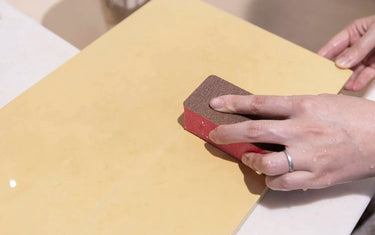
We took the rough side of the Hasegawa and got to work on the Parker Asahi cutting board. After a minute or two we rinsed it off, revealing a surprisingly lighter shade of light brown underneath. We’ve found that the Parker Asahi doesn’t get cut up nearly as easily as our other cutting boards, so what few cuts it had disappeared along with the stains. We were impressed; the Parker Asahi looked good as new.
Scraping an Old Wooden Board


Next, we cleaned and moistened my old wooden cutting board and got to scraping. We spent much more time scraping it, but in spite of that, we didn’t notice any visible difference. We used the “fine” side of the scraper and smoothed out the wood, but otherwise the board showed little visible differenced after scraping.
Getting the Most From Your Scraper

Our testing demonstrates two important principles.
- Don’t expect miracle results. If you have an old abused board like us, don’t expect the Hasegawa to fix it. Take a trip to Home Depot and prepare for some serious sanding.
- If you have a Parker Asahi board, you can expect some good results from scraping.
- Scraping should be done periodically for maximum benefit. Our Parker Asahi is only lightly used, so after one year of use it was only slightly stained. The wooden board we tested is old and had never been scraped before, leaving us with disappointing results. For your board at home, you should scrape more often.
Scraping removes material from your board: over many years, your board will slowly disappear. Using the “fine” side of the Hasegawa, you can scrape your board regularly without losing much material while also maintaining a fresh, clean appearance.
Because scraping removes material, you should also apply a protective oil to your wooden cutting board if you have it. The oil will help limit future staining and keep the board looking good.